
The Financial Impact of Pig Mortality—and Why You Should Track It
September 15, 2026
 Pig mortality is often recorded as a production figure.
A farmer may note that three piglets died during the week, one grower was lost to illness and a sow died during farrowing. These records help show how many animals remain on the farm, but they do not reveal the complete effect of those deaths.
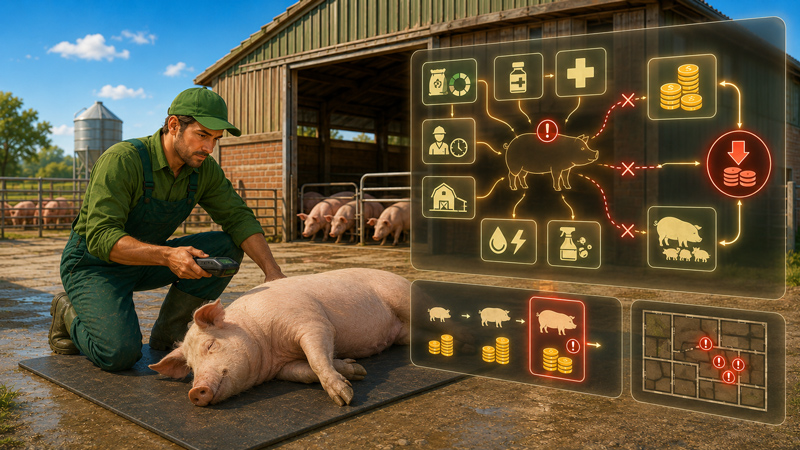
Every pig that dies also represents a financial loss.
The farm may have already spent money on feed, medication, labour, housing and breeding. The animal may have been expected to produce future piglets or generate income when sold. Once it dies, those accumulated costs cannot be recovered.
This is why mortality should not be treated only as an animal-count problem. It is also a cost, cash-flow and profitability problem.
Accurate mortality tracking helps farmers understand where deaths occur, what they cost and which losses may be preventable.
Pig mortality affects more than livestock numbers
When a pig dies, the most visible loss is the animal itself.
However, the financial effect extends beyond reducing the number of pigs on the farm. It can include:
- The cost of purchasing or breeding the animal
- Feed consumed before death
- Medication and veterinary expenses
- Labour already invested
- Housing, water and electricity
- Lost sales revenue
- Lost breeding potential
- Disposal and cleaning costs
- Reduced efficiency within the production group
- The risk of further deaths
The later the death occurs in the production cycle, the more accumulated costs are usually attached to the animal.
A newborn piglet has consumed fewer resources than a finisher that is almost ready for sale. But repeated piglet deaths can still create a large financial loss because they reduce the number of animals available for weaning, growing and future sale.
Each death needs to be understood in its proper production context.
The loss begins before the animal dies
Farmers sometimes calculate mortality losses using only the expected selling price of the animal.
That figure is important, but it does not tell the complete story.
Consider a grower that has been on the farm for several months. Before it dies, the farm may already have paid for:
- Breeding or purchase
- Milk or creep feed
- Weaner feed
- Grower feed
- Vaccinations
- Medication
- Labour
- Cleaning
- Water
- Electricity
- Housing
If the grower becomes ill, the farm may spend even more on treatment before losing it.
The death removes the possibility of recovering those costs through a future sale. It also means that part of the feed, labour and housing invested in the group produced no marketable output.
Mortality is therefore the loss of both the animal’s future value and the resources already consumed.
Piglet mortality reduces future production
Piglet deaths may appear financially smaller because young piglets have consumed less feed. However, high piglet mortality can severely weaken the farm’s future output.
Every piglet that dies represents:
- One fewer pig available for weaning
- One fewer grower or finisher
- Lower use of the sow’s reproductive potential
- Reduced future sales
- A possible sign of a broader management problem
Suppose two sows each produce 12 live piglets.
If the first sow weans 11 and the second weans only seven, their farrowing results may initially look similar. But the second litter produces four fewer pigs for the next stage.
If that pattern occurs across many sows, the farm can lose a substantial amount of future revenue.
Piglet mortality should be tracked separately from mortality among older pigs because its causes, timing and financial implications are different.
Useful piglet records include:
- Date of birth
- Litter and sow
- Number born alive
- Date of death
- Age at death
- Suspected cause
- Weight where available
- Treatment or intervention
- Number eventually weaned
This information helps reveal whether losses occur during birth, the first few days of life or later in lactation.
Weaner mortality can expose transition problems
Weaning is a demanding stage.
Piglets experience changes in diet, environment, social grouping and maternal contact. Their feed intake may decline, and health problems can emerge quickly.
Deaths during this stage may be connected to:
- Weaning stress
- Inadequate feed intake
- Poor water access
- Diarrhoea
- Disease
- Temperature problems
- Overcrowding
- Poor hygiene
- Abrupt feed changes
- Weak piglets entering the group
Financially, the farm has already invested in producing and raising these piglets through the pre-weaning period. Losing them shortly after weaning wastes that earlier investment and reduces the number of animals that can progress to market.
Weekly monitoring is important because several similar cases can become a pattern before the monthly report is prepared.
Grower and finisher deaths carry accumulated costs
The financial effect of mortality generally becomes larger as pigs progress through production.
Growers and finishers have consumed significant quantities of feed. Feed is often the largest cost associated with raising them, and none of that cost can be recovered if the pig dies before sale.
A finisher that dies shortly before reaching market weight may represent:
- Months of feed consumption
- Labour and housing costs
- Veterinary and medication expenses
- Lost sales revenue
- Disposal costs
- Possible disease risk to the remaining group
This is why a simple death count is insufficient.
Losing one nearly market-ready finisher may have a larger immediate financial effect than losing several newborn piglets. However, repeated piglet mortality may create a larger long-term production loss.
Both require attention, but they should not be valued identically.
Breeding-animal mortality has long-term consequences
The death of a sow or boar can affect production for months or years.
A breeding animal carries value beyond its body weight. It contributes to the farm’s ability to produce future litters.
The death of a productive sow may result in:
- Loss of the sow’s purchase or rearing value
- Loss of future litters
- Fewer piglets available for sale or finishing
- Cost of obtaining a replacement
- Time required for the replacement to become productive
- Disruption to the breeding schedule
- Lower use of available farrowing space
The death of a boar may also interrupt breeding, especially when the farm depends heavily on that animal.
When calculating breeding-stock losses, avoid assuming that every expected future litter would have been fully profitable. Future revenue is uncertain and would also involve future costs. However, the lost production capacity should still be recognised.
Count deaths by production stage
A single farm-wide mortality percentage can hide important problems.
For example, a farm may report an overall mortality rate that appears acceptable while experiencing serious losses among weaners. The large number of surviving finishers can make the farm-wide figure look less alarming.
Mortality should be grouped by production stage:
- Stillborn piglets
- Pre-weaning piglets
- Weaners
- Growers
- Finishers
- Breeding sows
- Boars
Each stage has different expected risks, causes and financial implications.
A useful basic calculation is:
Mortality rate = number of deaths ÷ number of animals at risk × 100
The “number of animals at risk” should be selected consistently. Depending on the farm and reporting period, it may use the opening number, average number or number entering the production stage.
Consistency matters more than choosing a calculation that makes the figure appear favourable.
The purpose is to compare performance honestly across periods and groups.
Every death needs an individual record
Mortality should be recorded when it occurs—not reconstructed at the end of the month.
A useful mortality record includes:
- Date
- Pig identification or group
- Production stage
- Age
- Weight or estimated weight
- Pen or location
- Symptoms observed
- Treatment given
- Suspected cause
- Confirmed diagnosis where available
- Disposal method
- Estimated financial loss
- Person who recorded the event
Do not leave the cause blank simply because it is uncertain. Record it as unknown or suspected rather than presenting an assumption as a confirmed diagnosis.
An inaccurate cause can send the farm in the wrong direction. Repeated or unexplained mortality should be evaluated with a veterinarian or other qualified animal-health professional.
Causes matter because they influence prevention
A mortality total tells the farmer how many pigs were lost. The recorded causes help explain what might need to change.
Possible categories include:
- Crushing
- Starvation or insufficient milk
- Stillbirth
- Diarrhoea
- Respiratory disease
- Injury
- Heat stress
- Poisoning
- Poor body condition
- Farrowing complications
- Unknown cause
The categories should be specific enough to support decisions but simple enough to be used consistently.
If many records remain classified as unknown, the farm has a visibility problem. It may need better observation, faster reporting, post-mortem examination or professional support.
The purpose is not to assign blame. It is to identify patterns that can guide prevention.
Calculate the direct financial loss
A practical direct-loss estimate can include the accumulated cost of raising the pig until the date of death.
Depending on available records, this may include:
- Purchase or allocated breeding cost
- Feed consumed
- Medication
- Veterinary treatment
- Vaccination
- Labour allocation
- Other direct production costs
- Disposal expenses
For example, suppose a finisher consumed ₦65,000 worth of feed, received ₦5,000 in treatment and carried ₦15,000 in other allocated production costs.
Its accumulated direct cost would be:
₦65,000 + ₦5,000 + ₦15,000 = ₦85,000
This does not yet include the revenue the farm expected from selling the pig.
The exact calculation will depend on the quality of the farm’s cost records. An approximate but consistently applied method is more useful than ignoring the cost entirely.
Estimate lost contribution—not just lost sales
Expected selling price is not the same as profit.
If a pig was expected to sell for ₦180,000, it would be misleading to call the entire amount lost profit. The farm would still have incurred additional feed, labour, transport and selling costs before the animal reached the market.
A more useful estimate is the lost contribution:
Expected sales revenue − costs that would still have been incurred
This separates the revenue that was lost from expenses the farm no longer has to pay because the pig died.
The calculation can become complex, so smaller farms may use a standard estimated value for each production stage.
For example, the farm could maintain an estimated financial value for:
- Newborn piglet
- Weaned piglet
- Grower
- Finisher
- Breeding sow
- Boar
These values should be reviewed as feed prices, market prices and production costs change.
Include disposal, cleaning and disease-control costs
The financial impact may continue after the death.
The farm may need to pay for:
- Carcass removal or disposal
- Disinfection
- Veterinary examination
- Laboratory testing
- Medication for exposed animals
- Additional labour
- Movement restrictions
- Replacement animals
- Production downtime
If the death is associated with a contagious disease, the cost can extend far beyond one animal.
The farm may also need to isolate groups, delay sales or implement additional biosecurity measures.
These costs should be recorded separately so the farm can understand the full effect of the event.
Carcass disposal must follow applicable animal-health, environmental and local regulatory requirements.
Investigate patterns by time, location and group
Individual mortality records become valuable when they are analysed together.
Look for patterns involving:
- The same pen
- The same age
- The same litter
- The same sow
- The same feed
- The same supplier
- The same treatment
- The same symptoms
- The same season
- The same employee shift
- The same production stage
For example, repeated deaths in one pen may indicate a problem with ventilation, flooring, temperature, water or hygiene.
Losses occurring shortly after a feed change may justify investigating the ration, storage or transition process. That relationship does not prove that the feed caused the deaths, but it identifies an area requiring examination.
Patterns allow the farmer to move beyond isolated explanations and investigate underlying conditions.
Compare mortality over time
A mortality rate has more meaning when it is compared with previous periods.
Review:
- Current weekly mortality
- Current monthly mortality
- Mortality by production stage
- Mortality by location
- Mortality by suspected cause
- Financial loss by group
- Changes after corrective actions
Do not wait for the annual total.
A yearly figure may show that mortality was high, but it arrives too late to prevent most of the losses. Weekly and monthly reviews provide earlier warnings.
Seasonal context also matters. Temperature, disease pressure, feed availability and farrowing patterns may influence mortality during certain periods.
The goal is not to excuse recurring losses but to interpret the figures properly.
Avoid normalising preventable deaths
Every livestock operation can experience mortality. The existence of deaths does not automatically mean that the farm is poorly managed.
The dangerous attitude is assuming that recurring losses are simply normal without examining them.
Statements such as “piglets always die” or “we lose a few finishers every month” can hide preventable problems.
Even when a mortality level cannot be reduced to zero, the farm should understand:
- Where deaths occur
- Why they may be occurring
- Whether the rate is changing
- What each loss costs
- Which preventive actions are realistic
- Whether those actions produce improvement
Acceptance without measurement turns avoidable losses into a permanent operating cost.
Do not react by cutting necessary care
When mortality costs become visible, a farmer may attempt to reduce expenses by limiting medication, vaccinations, veterinary support or essential feed.
That reaction can make the problem worse.
The objective is not to minimise every cost. It is to reduce preventable losses while protecting health and production.
A higher veterinary expense may be justified when it prevents a wider disease outbreak. Improved feed, housing or biosecurity may raise short-term costs but reduce mortality and increase future sales.
Decisions should be evaluated using their total effect, not only the immediate expense.
Turn mortality records into corrective actions
Each significant mortality pattern should lead to a defined response.
A useful corrective action includes:
- The problem observed
- The evidence supporting it
- The suspected contributing factors
- The action to be taken
- The person responsible
- The deadline
- The result to be measured
For example:
Pre-weaning mortality increased during the last two weeks, with most deaths occurring during the first three days after birth. The farm manager will review farrowing supervision, pen temperature and crushing incidents for every new litter during the next month.
This is more useful than writing “reduce piglet deaths.”
Specific actions create accountability and make follow-up possible.
Measure whether the intervention worked
Implementing a change does not prove that the problem has been solved.
After changing a farrowing procedure, repairing ventilation or adjusting group management, compare the new mortality results with the earlier period.
Ask:
- Did the mortality rate decline?
- Did the suspected cause occur less often?
- Was the improvement consistent?
- Did another problem appear?
- Did the intervention cost less than the losses it prevented?
- Should the change be retained or adjusted?
This creates a complete improvement cycle:
Record the death. Identify the pattern. Estimate the loss. Take action. Measure again.
How Pigax supports mortality management
Pigax helps farmers record mortality events and keep them connected to broader farm information.
Farmers can organise records relating to:
- Pigs and production groups
- Piglets and farrowing
- Mortality
- Feed usage
- Treatments and farm activities
- Income and expenses
- Reports
- Multiple farms
Connected records make it easier to review when deaths occurred, which animals or groups were affected and how mortality relates to production and financial performance.
Pigax cannot diagnose disease or determine the exact cause of death. Veterinary expertise, physical examination and laboratory testing may still be necessary.
Its value is providing a structured record that helps the farmer recognise patterns and understand their consequences.
A death that is not properly recorded becomes an invisible cost
Pig mortality affects animal numbers, production capacity, cash flow and profit.
When deaths are recorded only as occasional notes—or not recorded at all—the farmer loses the ability to determine where the losses occur and how expensive they are.
Strong mortality management requires more than counting dead pigs.
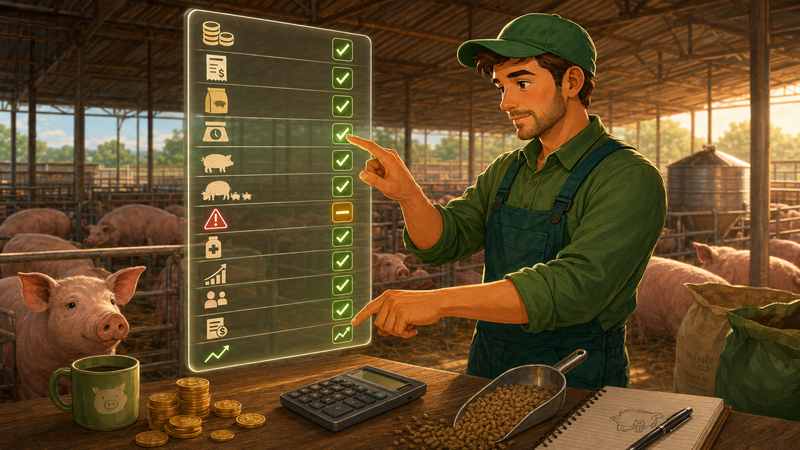
Farmers need to know:
- Which animals died
- When and where they died
- Their production stage
- The probable cause
- The resources already invested
- The revenue or production capacity lost
- Whether similar deaths are recurring
- What action should follow
Every death cannot be prevented. But every death can be recorded, reviewed and used to improve future decisions.
Use Pigax to record pig mortality, monitor production patterns and understand how animal losses affect your farm’s performance.