
How Feed Inventory Tracking Helps Control Farm Costs
September 22, 2026
 Feed is not merely something stored in bags until pigs need it. It is money that has already left the farm’s bank account.
Every bag represents working capital tied up in inventory. If the feed is stored correctly and used efficiently, it supports growth, reproduction and future sales. If it becomes mouldy, goes missing, expires or is issued without proper records, the farm loses money.
Yet many pig farms manage feed inventory by looking inside the store and deciding whether it appears full or empty.
That method may work when the farm is very small, but it becomes unreliable as the number of pigs, feed types, suppliers and employees increases. The farmer may know that feed was purchased without knowing how quickly it was consumed, which group received it or why the recorded quantity differs from the physical stock.
Feed inventory tracking creates visibility between purchasing and consumption.
It helps farmers understand what entered the store, what left it, what remains and whether the movement matches the farm’s production plan.
Feed inventory is part of financial management
A feed purchase immediately affects cash flow, but the feed may remain in storage for days or weeks before it is consumed.
This means feed inventory connects two important areas of farm management:
- Finance: how much money was spent purchasing feed
- Production: how much feed was used to produce pigs
When feed inventory is not tracked, the farmer may confuse purchasing activity with consumption.
For example, a farm may purchase a large quantity of feed at the end of the month. Expenses rise sharply, but most of the feed remains in storage. If the farmer treats the entire purchase as feed used during that month, production costs will appear unusually high.
The opposite can happen during the next month. The farm may purchase little feed because it is consuming existing stock. Expenses appear lower even though the pigs continue using feed every day.
Inventory records help separate cash spent from feed consumed.
Know the difference between feed purchased, stored and used
Three quantities should be tracked separately:
- Feed purchased: the quantity received from suppliers.
- Feed in inventory: the quantity currently available in storage.
- Feed used: the quantity issued to pigs or removed for another recorded purpose.
These figures are related, but they are not interchangeable.
A basic inventory calculation is:
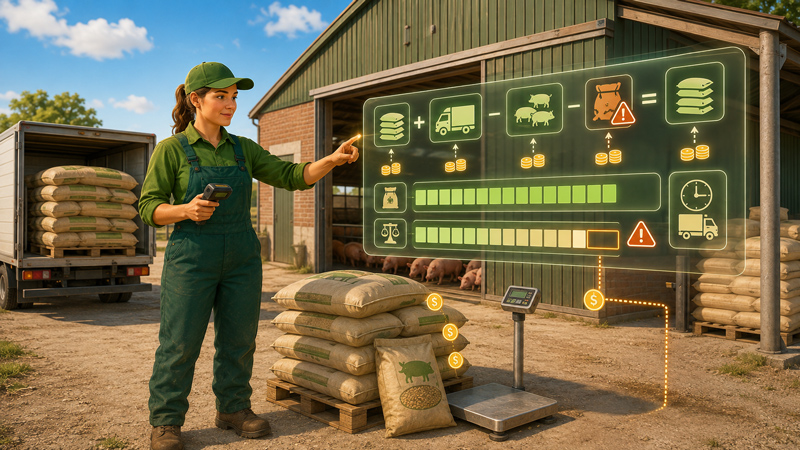
Opening inventory + feed received − feed issued − recorded losses = expected closing inventory
The expected closing inventory should then be compared with the physical stock.
For example, suppose a farm begins the week with 1,200 kilograms of grower feed. It receives 2,000 kilograms and issues 2,400 kilograms to the grower unit. Another 50 kilograms is recorded as damaged.
The expected closing balance is:
1,200 kg + 2,000 kg − 2,400 kg − 50 kg = 750 kg
If the physical count shows only 620 kilograms, the farm has an unexplained shortage of 130 kilograms.
That shortage has a financial value and requires investigation.
Record every feed delivery accurately
Inventory accuracy begins when feed enters the farm.
Each delivery record should include:
- Delivery date
- Supplier
- Feed type
- Number of bags
- Weight per bag
- Total weight
- Unit price
- Total purchase value
- Batch or production details where relevant
- Condition on arrival
- Person who received the delivery
Do not assume that every delivered bag contains the expected weight or that the quantity automatically matches the invoice.
Someone should count the bags and inspect their condition before confirming receipt. Where practical, sample bags can be weighed to verify their contents.
Check for:
- Torn or wet bags
- Signs of mould
- Contamination
- Pest damage
- Incorrect feed type
- Missing bags
- Incorrect bag size
- Unusual colour, smell or texture
Problems identified during delivery are easier to discuss with the supplier than problems discovered weeks later.
Use one standard measurement unit
Feed records become unreliable when different units are mixed without proper conversion.
A supplier may invoice in tonnes. Employees may issue feed in bags, buckets or scoops. Reports may display kilograms.
Choose one standard inventory unit—usually kilograms—and convert every movement into that unit.
For example:
- 20 bags × 25 kg = 500 kg
- 20 bags × 50 kg = 1,000 kg
Recording only “20 bags” would make these quantities look identical.
Scoops and buckets should also be calibrated. Weigh the feed held by each container and mark it clearly. This reduces differences between employees and improves the accuracy of daily feed-usage records.
Separate different feed types
Combining all feed into one inventory balance hides important information.
Piglets, growers, finishers and breeding animals require different feed formulations. Their feeds may also have very different prices.
Inventory records should distinguish relevant categories such as:
- Creep feed
- Weaner feed
- Grower feed
- Finisher feed
- Gestation feed
- Lactation feed
- Farm-mixed rations
- Individual ingredients
Separating feed types helps the farm determine:
- Which feed is running low
- Which feed is being used too quickly
- Which feed costs are increasing
- Whether the wrong feed is being issued
- Which stock is approaching expiry
- How much money is tied up in each category
It also reduces the risk of substituting one ration for another simply because the correct feed ran out unexpectedly.
Record every feed issue
A feed issue occurs whenever feed leaves storage.
The record should show:
- Date
- Feed type
- Quantity
- Receiving pen or group
- Number of pigs in the group
- Person issuing the feed
- Purpose or feeding period
- Any relevant notes
Recording only the quantity is not enough. Assigning feed to a group connects inventory movement to production.
If grower-feed stock is disappearing quickly, the farmer can compare the usage with the number of growers, their weights and the feed plan.
Feed removed for another purpose should also be recorded. This includes feed used for newly arrived animals, transferred to another farm, returned to a supplier or used during an emergency.
Every movement needs an explanation.
Compare feed issues with the feed plan
Inventory records become more valuable when actual usage is compared with expected usage.
A feed plan estimates how much a production group should receive based on factors such as:
- Number of pigs
- Age or weight
- Production stage
- Feed type
- Daily allocation
- Duration
Suppose a group of growers is expected to use 700 kilograms during the week but the store issues 900 kilograms.
The 200-kilogram difference does not automatically prove theft or waste. The group may have more pigs, heavier pigs or a revised feeding requirement.
But the difference gives the farmer a reason to investigate.
Without a feed plan, excessive consumption can continue without being noticed because there is no expected figure for comparison.
Feed requirements should be developed or reviewed with appropriate nutritional guidance. Inventory controls should never be used to justify underfeeding animals.
Carry out regular physical stock counts
Digital or written records show what should be in storage. A physical count confirms what is actually there.
The frequency of stock counts depends on the farm’s size and feed movement. High-value or fast-moving feed may need to be checked weekly or even more frequently.
During the count:
- Count unopened bags
- Confirm the weight per bag
- Estimate or weigh opened bags
- Separate damaged stock
- Check each feed type independently
- Record the date and person counting
- Compare the result with the expected balance
Whenever possible, the person checking the stock should not simply copy the recorded quantity. The physical count must be independent enough to reveal differences.
Any discrepancy should be recorded rather than silently adjusting the system to match the physical balance.
Silent adjustments remove the evidence that a problem exists.
Investigate inventory discrepancies
An inventory discrepancy is the difference between the expected quantity and the physical quantity.
A shortage may be caused by:
- Feed issued without being recorded
- Incorrect measurements
- Spillage
- Theft
- Torn bags
- Rodent or bird damage
- Delivery shortages
- Incorrect data entry
- Feed transferred elsewhere
- Unrecorded disposal
An excess may result from:
- A purchase recorded incorrectly
- Usage entered twice
- Wrong bag-size conversion
- Feed returned but not recorded
- Measurement errors
Do not immediately assume dishonesty. Weak procedures and inconsistent measurement are common causes.
However, repeated unexplained shortages should not be accepted as normal. The farm should identify where the process breaks down and assign corrective action.
Calculate the financial value of discrepancies
A shortage should be translated into money.
Suppose the farm is missing 130 kilograms of grower feed, and that feed costs ₦900 per kilogram.
The inventory loss is:
130 kg × ₦900 = ₦117,000
A quantity that appears small on a large farm may represent a substantial financial loss when repeated every week.
Calculating the monetary value helps determine how urgently the problem should be addressed. It also makes the cost of weak controls visible to managers and employees.
Over time, track:
- Quantity lost
- Financial value lost
- Feed type affected
- Location
- Probable reason
- Corrective action
- Whether the loss continued
Monitor storage conditions
Accurate records cannot protect feed that is stored badly.
The feed store should be regularly checked for:
- Moisture
- Roof or pipe leaks
- Mould
- Rodents
- Birds
- Insects
- Torn bags
- Contamination
- Excessive heat
- Direct floor contact
- Poor ventilation
- Unauthorised access
Feed should be stored according to appropriate safety and quality requirements. Bags are commonly kept off the floor and away from walls where moisture can accumulate.
The store should also be organised so employees can identify each feed type easily.
Poor organisation increases the risk of using the wrong ration, overlooking damaged stock or allowing old feed to remain unused.
Use older suitable stock first
Feed should generally be issued in a controlled order so older suitable stock is used before newer stock.
A first-in, first-out approach reduces the likelihood of feed remaining in storage until it expires or deteriorates.
However, the farm should also consider expiry dates and feed condition. A newer delivery with a shorter usable period may need attention sooner.
Label or arrange stock using:
- Delivery date
- Feed type
- Batch
- Expiry or recommended-use date
- Supplier
Do not mix old and new stock in a way that makes traceability impossible.
If a quality problem occurs, batch and delivery information can help the farm identify which animals received the affected feed.
Record damaged and spoiled feed separately
Feed that becomes mouldy, wet, contaminated or otherwise unsuitable should not disappear as ordinary consumption.
Record:
- Feed type
- Quantity
- Date discovered
- Reason for damage
- Storage location
- Financial value
- Disposal or return method
- Corrective action
If spoiled feed is simply removed from the store without a record, the inventory system may suggest that pigs consumed it. This distorts feed-efficiency calculations and hides the storage loss.
Do not feed visibly spoiled or suspect feed simply to avoid recognising the financial loss. That can create health problems and potentially cause much larger losses.
Seek appropriate professional advice where feed safety is uncertain.
Avoid excessive inventory
Running out of feed is dangerous, but holding too much inventory also creates costs.
Excess stock ties up money that could be used for labour, veterinary care, repairs or other operations. It also increases the risk of:
- Spoilage
- Expiry
- Pest damage
- Theft
- Price changes
- Storage overcrowding
- Using outdated formulations
The farm should determine how much safety stock is genuinely required.
This depends on:
- Daily feed usage
- Supplier reliability
- Delivery time
- Storage capacity
- Seasonal disruption
- Price volatility
- Availability of ingredients
- Financial resources
Buying in bulk may reduce the price per kilogram, but the saving is worthless if part of the feed is damaged before use.
Prevent feed shortages
A feed shortage can disrupt the ration programme, force emergency purchases or cause the farm to use an unsuitable substitute.
Inventory tracking helps establish a reorder point.
A simple calculation is:
Reorder point = expected usage during delivery time + safety stock
Suppose a farm uses 300 kilograms of grower feed per day. Its supplier normally needs four days to deliver, and the farm wants two additional days of safety stock.
The reorder point would be:
300 kg × 6 days = 1,800 kg
When the inventory reaches approximately 1,800 kilograms, the farm should place the next order.
The calculation should be adjusted when pig numbers, consumption or supplier lead times change.
Use inventory data to improve purchasing
Feed purchasing should be based on expected consumption, available stock and production plans—not only on habit or supplier pressure.
Before placing an order, review:
- Current physical inventory
- Recorded inventory balance
- Expected feed usage
- Pig numbers
- Upcoming weaning or sales
- Available storage
- Supplier delivery time
- Current and expected prices
- Available cash
- Outstanding feed orders
If a large group of finishers will be sold soon, future feed requirements may fall. If several litters will be weaned, demand for weaner feed may rise.
Production information helps the farmer purchase the right feed in the right quantity.
Compare supplier performance
Inventory records can also reveal supplier problems.
Track:
- Quantity ordered
- Quantity received
- Delivery delays
- Bag weights
- Product condition
- Price changes
- Quality complaints
- Returns
- Payment terms
A supplier offering the lowest price may not provide the best value if deliveries are regularly short, late or damaged.
Reliable records give the farmer evidence when discussing discrepancies and make supplier comparisons more objective.
Control access to the feed store
Feed inventory is difficult to control when anyone can enter the store and remove stock without recording it.
The farm should define:
- Who may receive deliveries
- Who may issue feed
- Who records movements
- Who performs stock counts
- Who approves adjustments
- Who investigates discrepancies
This does not require a complicated bureaucracy.
Even a small farm benefits from clear responsibility. One employee should not be blamed for a discrepancy when several people can remove feed without leaving a record.
Access controls and consistent procedures protect both the farm and its employees.
Train workers to understand why records matter
Employees may see feed records as extra paperwork unless the purpose is explained.
They need to understand that accurate records help the farm:
- Keep feed available
- Avoid emergency shortages
- Reduce waste
- Protect jobs and profitability
- Allocate feed correctly
- Identify damaged equipment
- Investigate health or growth problems
- Plan purchases
The recording process should also be practical.
If staff must leave the production area, find a manager and complete a complicated form every time feed is issued, the process is likely to fail.
Use simple, consistent records that fit the farm’s actual workflow.
Connect inventory with production performance
A perfectly balanced inventory does not prove that feed is being used efficiently.
The farm may record every kilogram accurately while pigs gain weight slowly or sows perform poorly.
Inventory should therefore be reviewed alongside:
- Pig numbers
- Weight gain
- Feed conversion
- Mortality
- Health events
- Reproductive performance
- Time to market
- Feed costs
- Sales results
The real question is not only whether the feed can be accounted for.
It is whether the feed produced an acceptable result.
If one group consumes more feed but gains less weight than a comparable group, the farmer should investigate feed quality, health, water, housing, genetics, waste and record accuracy.
Review feed inventory weekly
A practical weekly inventory review should answer:
- What was the opening balance?
- What feed was delivered?
- What feed was issued?
- Which groups received it?
- What losses were recorded?
- What should remain?
- What is physically available?
- Are there unexplained differences?
- Which feed is running low?
- Which feed may expire or deteriorate?
- What needs to be ordered?
- Does usage match the feed plan?
A monthly review can then identify broader changes in price, consumption, losses and production performance.
Frequent review allows the farm to act while the records are recent and discrepancies are easier to investigate.
How Pigax supports feed inventory management
Pigax helps pig farmers organise feed plans, usage and inventory records alongside other production and financial information.
Farmers can use Pigax to:
- Record feed inventory
- Track feed usage
- Manage feed plans
- Connect usage to farm activities
- Record income and expenses
- Review production information
- Generate reports
- Manage multiple farms
Connected records help farmers understand not only how much feed was purchased, but also how it moved through the farm and how it affected production costs.
Pigax does not replace physical stock counts, good storage, staff supervision or professional nutritional advice. Its role is to provide the organised records needed to make those controls more effective.
Feed inventory should never be a mystery
A farmer should be able to explain four things about feed:
- What entered the farm
- What left the store
- Where it went
- What remains
When those answers are missing, waste, shortages and financial losses can continue unnoticed.
Accurate feed inventory tracking turns stored feed into a controlled business asset. It helps farmers purchase with greater confidence, reduce preventable losses and connect feed spending to actual production.
Every bag has a cost.
Every movement should have a record.
Use Pigax to track feed inventory, organise feed usage and understand how feed movement affects your pig farm’s costs.