
Feed-Cost Tracking Mistakes That Can Hide Financial Losses
September 29, 2026
 Feed is one of the largest and most important costs in pig production.
Every pig needs the right quantity and quality of feed to grow, reproduce and remain healthy. But purchasing more feed does not automatically produce better results. If feed is wasted, stored poorly, allocated incorrectly or consumed by pigs that are growing too slowly, the farm may spend heavily without receiving enough value in return.
The problem is that many feed losses are not immediately visible.
A farmer may notice that feed expenses are increasing but not know whether the cause is a higher supplier price, more pigs, excessive usage, damaged feed, theft or poor growth performance. The farm may continue selling pigs and receiving income while the profit from each animal gradually declines.
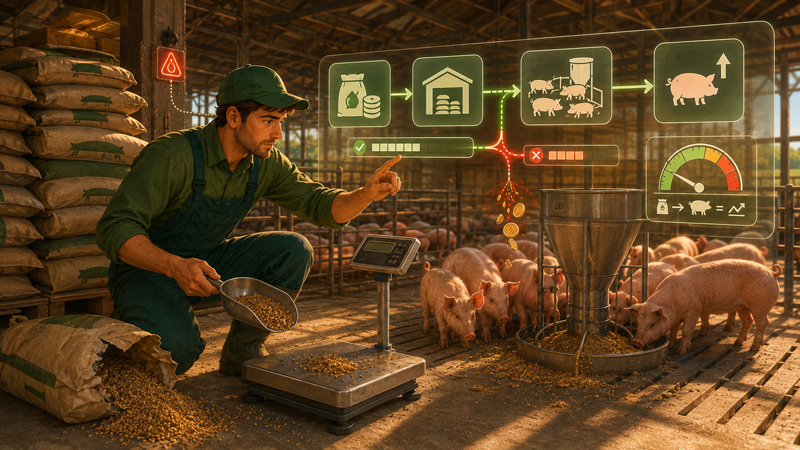
Accurate feed-cost tracking connects three things:
- How much feed the farm buys
- How much feed the pigs consume
- What production result the feed produces
When any of these records are incomplete, financial losses can remain hidden.
Mistake 1: Recording feed purchases but not feed consumption
A feed purchase records what entered the farm. It does not show what the pigs actually consumed.
Suppose a farmer buys 100 bags of feed during the month. Some of those bags may remain in storage. Others may replace stock purchased during the previous month. A few may be damaged or used for a different group than originally planned.
Treating the entire purchase as feed consumed during the month produces a distorted result.
The correct starting point is:
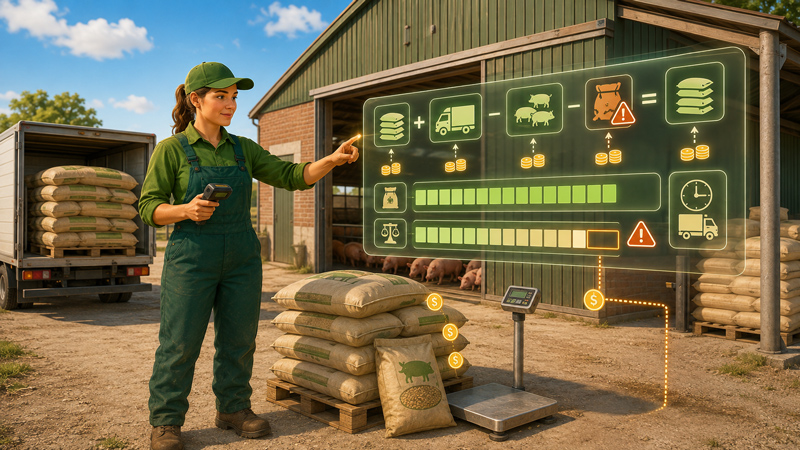
Opening feed inventory + feed purchased − closing feed inventory = estimated feed used
For example, a farm starts the week with 20 bags, purchases another 50 and ends with 15 bags.
The estimated usage is:
20 + 50 − 15 = 55 bags
This calculation still needs to account for damaged, returned or missing feed, but it provides a better estimate than using purchases alone.
Without consumption records, the farmer cannot determine whether feed usage matches the number and type of pigs on the farm.
Mistake 2: Treating feed purchases and feed costs as the same thing
Feed purchases influence cash flow, but feed consumption influences production cost.
A farmer may purchase several months of feed at once to benefit from a lower price or prepare for an expected shortage. The bank balance will fall immediately, but the feed will support production over a longer period.
If the entire purchase is treated as an expense for the current month, that month may appear unprofitable. Later months may then appear unusually profitable because the pigs consume feed that was paid for earlier.
This creates misleading monthly comparisons.
Farmers should monitor both:
- Cash spent on feed: useful for managing available money and supplier payments.
- Value of feed consumed: useful for understanding production cost.
Both figures matter, but they answer different questions.
Mistake 3: Failing to record opening and closing inventory
Without opening and closing inventory, it is impossible to calculate how much feed disappeared from storage during a period.
The farmer may know what was purchased, but not whether the feed was consumed, wasted, damaged or remains available.
A regular physical count should record:
- Feed type
- Number of unopened bags
- Estimated quantity in opened bags
- Weight per bag
- Total quantity available
- Cost or average value
- Damaged or spoiled stock
The physical count should be compared with the recorded balance.
If the system shows 1,500 kilograms but only 1,300 kilograms can be found, the farm has an unexplained difference of 200 kilograms.
That difference has a financial value. Ignoring it allows the loss to disappear inside the total feed bill.
Mistake 4: Recording all feed as one category
Piglets, growers, finishers, pregnant sows and lactating sows have different nutritional needs.
When all feed is recorded under one general category, the farmer cannot determine which production group is driving the cost.
Separate records should be maintained for relevant feed types, such as:
- Creep feed
- Weaner feed
- Grower feed
- Finisher feed
- Gestation feed
- Lactation feed
- Farm-mixed rations
The exact categories will depend on the feeding programme.
Separating feed types helps answer practical questions:
- Is expensive piglet feed being used by older pigs?
- Are growers consuming more feed than planned?
- Are lactating sows receiving the correct ration?
- Which feed price increased?
- Which group is responsible for the rise in usage?
A single total feed figure hides these differences.
Mistake 5: Not assigning feed usage to a group
Recording that 500 kilograms of feed left the store is not enough.
The farmer should know which pigs received it.
Feed usage should be assigned to the relevant pen, group or production stage. This connects feed consumption with the number of pigs, their age and their performance.
For example, suppose two grower groups contain the same number of pigs. One group consumes significantly more feed but gains less weight. Without group-level records, the poor performance may remain hidden inside the farm’s total consumption.
Assigning usage to groups makes comparisons possible.
However, the group records must remain current. If pigs are sold, transferred or die without being removed from the group, feed-per-pig calculations will be wrong.
Mistake 6: Using inconsistent units of measurement
One worker records feed in bags. Another records kilograms. A supplier uses tonnes. Opened bags are estimated without a standard method.
This inconsistency creates calculation errors.
A “bag” is not a reliable measurement unless every bag contains the same quantity. Suppliers or feed types may use different bag sizes.
Choose one standard unit—usually kilograms—for inventory, usage and cost calculations.
For example:
- 10 bags × 25 kg = 250 kg
- 10 bags × 50 kg = 500 kg
Both records show 10 bags, but the actual quantities are completely different.
Staff should record the bag size and convert the quantity into the farm’s standard unit.
Mistake 7: Ignoring changes in feed price
Feed usage can remain stable while feed cost increases.
If the farmer looks only at the total amount spent, the increase may be wrongly blamed on waste or higher consumption. The actual cause may be a supplier price change.
Every purchase record should include:
- Feed type
- Quantity
- Unit price
- Total price
- Supplier
- Purchase date
- Transport cost where relevant
Tracking the unit price makes it possible to separate price changes from usage changes.
For example, if feed cost rises by 15% while consumption remains unchanged, the farm needs to review supplier pricing, ration cost or selling prices. Reducing feed allocation blindly would damage production without solving the real problem.
Mistake 8: Excluding transport and handling costs
The supplier’s invoice price may not represent the full cost of getting feed to the farm.
The real cost may also include:
- Transportation
- Loading
- Unloading
- Storage
- Milling
- Mixing
- Packaging
- Taxes or other charges
- Losses during transport
If a farmer buys feed for ₦1,000,000 and spends another ₦100,000 transporting and handling it, the landed cost is ₦1,100,000.
Ignoring the additional ₦100,000 understates the cost per kilogram and makes production appear more profitable.
Relevant additional costs should be included consistently, especially when comparing different suppliers or buying methods.
Mistake 9: Ignoring feed waste
Feed can disappear without producing animal growth.
Common causes include:
- Feeders adjusted incorrectly
- Pigs throwing feed onto the floor
- Torn bags
- Spillage during distribution
- Rodents or birds
- Rain or moisture
- Mould
- Poorly secured storage
- Incorrect mixing
- Expired ingredients
- Theft
Waste should be recorded separately from normal consumption whenever possible.
If damaged feed is simply removed from inventory, the records may suggest that pigs consumed it. That makes their feed efficiency appear worse while hiding the real storage or handling problem.
Recording the reason for the loss helps the farmer identify recurring patterns.
For example, repeated spillage in one pen may indicate a damaged feeder. Frequent mould may indicate poor ventilation or moisture in the store.
Mistake 10: Estimating every feed issue
Estimation may be necessary when precise equipment is unavailable, but repeated guessing creates unreliable records.
One worker may consider a scoop to contain three kilograms while another assumes it contains four. Over hundreds of feedings, the difference becomes substantial.
Farms should standardise the tools and methods used to issue feed.
This may involve:
- Weighing a full scoop
- Marking feed containers
- Using calibrated buckets
- Recording the number of units issued
- Installing scales where practical
- Training employees to follow the same method
The system does not need to be expensive. It needs to be consistent.
A cheap container with a known capacity provides better information than an unmeasured shovel.
Mistake 11: Recording feed after several days
Delayed recording depends on memory.
A worker may issue feed to several pens throughout the week and attempt to enter everything later. By then, quantities, dates and groups can easily be confused.
The records may look complete while containing inaccurate estimates.
Feed should be recorded as close as practical to the time it is issued. Where immediate digital entry is not possible, use a simple daily sheet and transfer the information into the main system promptly.
Delays also make it harder to investigate inventory discrepancies. If the store balance is incorrect, recent records provide a much clearer path than reconstructed information from several weeks earlier.
Mistake 12: Failing to adjust for changes in pig numbers
Feed usage must be interpreted alongside the number of pigs consuming it.
A group that used more feed this month may simply contain more animals. Another group may use less because several pigs were sold or died.
Useful calculations include:
Feed per pig = total feed used ÷ average number of pigs
However, the average number of pigs should reflect significant changes during the period.
If a group started with 100 pigs but 40 were sold halfway through the month, dividing the total feed by 100 would understate usage per pig. Dividing by 60 would overstate it.
For practical farm management, shorter review periods and accurate movement records improve the calculation.
Births, purchases, sales, deaths and transfers should be entered promptly so feed analysis uses realistic animal numbers.
Mistake 13: Tracking feed usage without tracking weight gain
Low feed consumption is not automatically a success.
A farmer may be pleased that a group consumed less feed than planned. But if those pigs also gained less weight, they may remain on the farm longer and consume more feed over their complete production cycle.
Feed should be evaluated in relation to production.
For growing pigs, an important measure is the feed conversion ratio:
Feed conversion ratio = feed consumed ÷ weight gained
If a group consumes 3,000 kilograms of feed and gains 1,000 kilograms of body weight, its feed conversion ratio is 3.0.
This means the group consumed approximately three kilograms of feed for each kilogram of weight gained.
A worsening ratio may indicate:
- Poor feed quality
- Disease
- Incorrect formulation
- Heat stress
- Poor water access
- Overcrowding
- Genetic differences
- Excessive feed waste
- Inaccurate weight or feed records
Feed conversion should be interpreted carefully because measurement errors can produce misleading results. But even an approximate, consistently calculated ratio is more useful than tracking feed usage alone.
Mistake 14: Comparing groups that are not comparable
Two groups may consume different quantities because they are at different production stages.
Lactating sows naturally have different requirements from pregnant sows. Young piglets use feed differently from finishers. A sick group should not be compared directly with a healthy group without context.
Meaningful comparisons should consider:
- Age
- Weight
- Breed or genetics
- Production stage
- Feed type
- Health status
- Housing conditions
- Number of pigs
- Duration of the measurement period
Comparisons are useful only when the conditions are sufficiently similar or the differences are clearly acknowledged.
Otherwise, the farmer may change a feed plan based on a false conclusion.
Mistake 15: Ignoring farm-mixed feed ingredients
Farmers who formulate or mix their own feed need to track more than the finished ration.
Each ingredient has its own:
- Quantity
- Purchase price
- Storage loss
- Nutritional role
- Inventory level
- Expiry or deterioration risk
The true cost of a mixed ration should include every ingredient and relevant processing expense.
If maize, soybean meal, premix and other ingredients are recorded separately but never combined into the cost of the finished feed, the farmer cannot accurately estimate feed cost per kilogram.
Changes in formulation should also be recorded. Otherwise, a difference in pig performance may be blamed on the animals when the ration itself changed.
Feed formulation should be developed or reviewed with qualified nutritional guidance. The cheapest mixture is not necessarily the most economical if it reduces growth, reproduction or health.
Mistake 16: Focusing only on the cheapest supplier
A lower purchase price can reduce costs, but price alone does not determine feed value.
Cheap feed may contain inconsistent ingredients, lower nutrient density, excessive moisture or poor-quality raw materials. If pigs need to consume more feed or grow more slowly, the apparently cheaper option may cost more per kilogram of weight gained.
Supplier comparisons should consider:
- Price per kilogram
- Transport cost
- Feed consistency
- Storage life
- Animal performance
- Delivery reliability
- Quantity shortages
- Quality complaints
- Payment terms
The best-value feed is the one that supports the required production result at a competitive total cost.
Without performance records, the farmer cannot judge value accurately.
Mistake 17: Not setting expected usage
Actual feed usage becomes more useful when it can be compared with a plan.
Each production group should have an expected feeding level based on the farm’s ration programme and appropriate professional guidance.
The plan should consider:
- Number of pigs
- Age or weight
- Production stage
- Feed type
- Daily allocation
- Duration
- Expected total usage
If actual usage differs significantly from the plan, the farmer has a reason to investigate.
The plan is not a rigid target that should override animal health or changing conditions. Lactating sows, sick animals and pigs under heat stress may require adjustments.
Its purpose is to create an expected reference point so unusual consumption does not go unnoticed.
Mistake 18: Treating unexplained differences as normal
Inventory differences are sometimes accepted as an unavoidable part of farming.
Small measurement differences may occur, especially when weighing opened bags. But repeated or large discrepancies should never be dismissed without investigation.
Calculate:
Expected closing inventory = opening inventory + purchases − recorded usage − recorded losses
Compare the expected quantity with the physical stock.
If the physical stock is consistently lower, possible causes include:
- Unrecorded feed issues
- Measurement errors
- Waste
- Theft
- Incorrect deliveries
- Damaged stock
- Poor recordkeeping
Assign someone to investigate the difference and correct the process. Repeated unexplained losses can silently consume a significant share of the farm’s profit.
Build a stronger feed-cost review
A useful weekly feed review should answer the following questions:
- How much feed was purchased?
- What was the unit price?
- How much feed was issued?
- Which groups received it?
- How many pigs were in those groups?
- How much feed should they have used?
- How much remains in storage?
- Does the physical inventory match the records?
- Was any feed wasted, damaged or lost?
- Did the pigs achieve the expected growth or production result?
- Which differences require investigation?
At the monthly level, the farmer should also compare feed usage, prices and performance with previous periods.
The objective is not to generate more paperwork. It is to find where money is leaving the business without producing sufficient value.
How Pigax helps farmers track feed costs
Pigax helps pig farmers organise feed plans, feed usage, inventory and other production records.
Farmers can use the system to connect feed information with their pigs, groups and broader farm performance. Income, expense and mortality records provide additional context for understanding whether production is financially sustainable.
Consistent digital records make it easier to:
- Monitor feed inventory
- Record feed usage
- Organise feed plans
- Review farm expenses
- Compare production information
- Detect unusual changes
- Produce reports
Pigax cannot determine the cause of every feed problem automatically. Physical stock checks, accurate weighing, farm observation and professional nutritional or veterinary advice remain essential.
What the system provides is a clearer record of what entered the farm, what was used and what happened afterwards.
Every kilogram should have a purpose
Feed costs do not become dangerous only when prices rise.
They become dangerous when the farmer cannot explain where the feed went or what result it produced.
A farm may lose money through a damaged feeder, inaccurate records, poor storage, slow growth or a ration that appears cheap but performs badly. Without connected feed, inventory and production records, those losses blend into the normal cost of farming.
Strong feed-cost control follows a simple principle:
Know what you bought, know what you used, know which pigs received it and know what result it produced.
When those four answers are available, hidden losses become much harder to ignore.
Use Pigax to manage feed plans, record feed usage, monitor inventory and understand how feed costs affect your pig farm.